
Finding our safe spaces in life with hypoparathyroidism
When hypopara gets scary, a columnist finds comfort in the bond with her son
Written by |




“No day shall erase you from the memory of time.” — Virgil
Having hypoparathyroidism makes my life different from most people’s. It’s not easy to put into words all the feelings that come with this rare disorder, which affects so many parts of my life.
Lately, I haven’t been sleeping very well. I’ve tried medicine, lavender baths, turning off my screens before bed, and even buying new sheets that I love, but nothing has helped. My mind just keeps racing instead of sleeping.
I’ve noticed that I sleep better on nights when I talk to my son, Harrison. While he can’t solve all of my sleep problems, and I don’t expect him to, he does help me feel calm when things are hard. Hearing his voice makes me feel safe.

My safe space
I recently received an email with the dates of my second study visit for Ascendis Pharma’s PaTHway60 Phase 3 clinical trial. The timing felt right because I needed to talk to my doctor about my insomnia. I wrote down the appointment and flight details on my calendar and added a note about sleep so that I wouldn’t forget to bring it up.
I noticed that I’d be flying home on Sept. 11. That date made me think about how Harrison was my safe space back in 2001, a day I’ll never forget, even with brain fog.
Harrison was just 3 weeks old at the time, and I’d been living with hypoparathyroidism for almost three years. He wasn’t sleeping, so I took him to his pediatrician.
On the drive, we listened to “The Howard Stern Show.” Stern was in the middle of a bit and sounded confused as he talked about a building on fire. I waited for the punch line, but instead, the show abruptly ended just as we arrived at the doctor’s office.
As the day went on, I felt anxious. The world had changed following the attacks. I had my first panic attack. How would I get my calcium? How would Harrison get his formula? Because of hypopara, I couldn’t breastfeed, so formula was a must.
Harrison was admitted to the hospital. Looking back, I don’t think he was truly sick. I now believe that his crying at night was because he wanted to be close to me. But that night, holding him helped calm my own fears.
Little by little, we both calmed down. I had my calcium, and Harrison had his formula. We were safe in the hospital and cared for by wonderful people, even though everyone was scared. I thought I was there to protect him, but as I lay there, I realized that he was actually the one holding me together.
I had thought it was my job to be the strong one. When he cried, I rocked him. When my calcium dropped, I smiled through the tingling and told him everything would be OK. But at some point, things changed.
A bond built from tragedy
In 2016, I had a serious calcium crash. When Harrison came home from summer camp, he went straight to my hospital room. As soon as he climbed into my hospital bed, I felt better. Just being with him soothed me, the same way I had always soothed him.
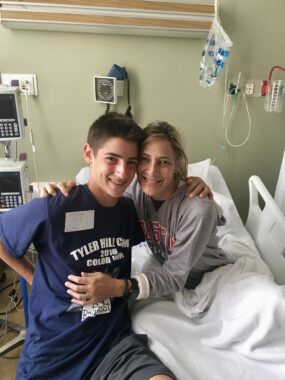
Bari Vapnek’s son, Harrison, visits her in the hospital after arriving straight from the airport in 2016. (Courtesy of Bari Vapnek)
Whether I need him or he needs me, we comfort each other. Living with hypoparathyroidism has taught me how much it means to have someone who understands you and helps you feel safe.
When my hypopara flares, he’ll notice in the way I hold my shoulders or go quiet. He’ll sit close without being asked, crack a joke, or say, “I’m here.” He helps to put me back together.
On nights when my mind races, he’ll talk to me about anything and everything, such as sports, work, or random memories. As we talk, I’ll feel my breathing slow down. We laugh, cry, and lean on each other.
Harrison can’t fix my illness or take away every fear, but to me, he makes the world feel safe. He is my safe space and my calm in every storm.
I’m grateful for those nights when he pressed close to my heart, and for our nightly phone calls now, when his voice reaches across the miles and helps to calm me down.
Out of tragedy, we built a shelter in each other. The world healed, and so did we.
No matter how loud my hypopara, anxiety, or the world outside gets, I know that as long as I have Harrison, I can always find my way back home.
Note: Hypoparathyroidism News is a strictly news and information website about the disease. It does not provide medical advice, diagnosis, or treatment. This content is not intended to be a substitute for professional medical advice, diagnosis, or treatment. Always seek the advice of your physician or another qualified health provider with any questions you may have regarding a medical condition. Never disregard professional medical advice or delay in seeking it because of something you have read on this website. The opinions expressed in this column are not those of Hypoparathyroidism News or its parent company, Bionews, and are intended to spark discussion about issues pertaining to hypoparathyroidism.


Leave a comment
Fill in the required fields to post. Your email address will not be published.